Sunday, November 27, 2011

Lawatan ke 9M4CCM

Penulis mengambil kesempatan bekerja di 40m band

Kenwood TS 430s

Cuti hujung minggu disusuli cuti Maal Hijrah diambil kesempatan oleh penulis untuk pulang ke kampung halaman di Kuala Terengganu. Penulis sempat berkunjung ke Club House Pemancar Terengganu (9M4CCM) .Kehadiran penulis telah disambut oleh 9M2BAL yang kebetulan turut berada disitu. Penulis sempat berada di 7.140MHz bersama 9M2ODY di Johor Baru dengan menggunakan  setup di situ iaitu Kenwood TS 430s dan Dipole Inverted V setup. Walaupun radio tersebut agak berusia, tetapi masih mampu lagi memberi prestasi yang baik. Di waktu yang sama, kelas persediaan RAE juga turut diadakan di ClubHouse tersebut bagi calon-calon yang akan mendudukinya pada 15 Disember ini. Tenaga pengajar terdiri dari 9M2VOT dan juga 9M2MSL.

Tuesday, November 22, 2011

Eyeball Qso Bersama 9M2RDX


Semalam sempat Eyeball Qso di Paka bersama 9M2RDX yang dalam perjalanan pulang ke Temerloh . Beliau telah berada selama 3 hari di Kuala Terengganu bagi menghadiri 12th Malaysian Jamboree , Terengganu International Scout Jamboree 2011 yang berlangsung dari 18 hingga 25 Nov 2011 di Kg.Telaga Batin, Seberang Takir, Kuala Terengganu. Di eyeball tersebut, kami sempat bertukar-tukar fikiran dan pendapat berkenaan dunia radio amatur di samping menimba pengalaman dari beliau tentang dunia HF. Sebelum bertolak pulang, beliau sempat memberi sekeping QSL Card sebagai tanda kenang-kenangan. Terimaksih kepada beliau kerana sudi meluangkan sedikit masa singgah di Paka.

Tuesday, November 15, 2011

UNDERSTAND PROPOGATION IN HF BANDS

160m-band (1.8-2.0 MHz)
160m band offers reliable working over range up to 25 miles during daytime. On winter nights ranges up to several thousand miles.

80m-band (3.5-3.8 MHz)
During the day time 80m-band covers upto about 200 miles. This band is more useful during the night because the range is several thousand miles. Transoceanic contacts are regularly made during the winter months. During the summer the static level is high.


40m-band (7.0-7.2 MHz)
40m-band has many of the characteristics as 80m-band except that the distance, that can be covered during the day and night hours are increased. Day-light distance upto about thousand miles and during winter nights it is possible to work stations as far as the other side of the world. The signals following the darkness path. Summer static is much less of a problem than on 80m.


20m-band (14.0-14.35 MHz)
This is the best amateur band for DX work. During the high portion of the sunspot cycle it is open to some part of the world practically throughout the 24 hours, while during a sunspot minimum it is generally useful only during twilight hours and the dawn and dusk periods. There is practically always a skip zone on the band.

15m-band (21.0-21.45 MHz)
15m-band shows highly variable characteristics depending on the sunspot cycle. During sunspot maximum it is useful for long distance work during a large part of the 24 hours, but in years of low sunspot activity it is almost wholly a daytime band, and sometimes unusable even in daytime. However, it is often possible
to use it for distances up to 1500 miles or more.

10m-band (28.0-29.7 MHz)
10m-band is generally considered to be a DX-band during the daylight hours (except in summer) and good for local work during the hours of darkness, for about half the sunspot cycle. At the sunspot minimum the band is usually dead.

Sunday, November 13, 2011

Lawatan 9M2VOT & 9M2BAL

Pada tanggal 11.11.2011 yang lepas, saya telah menerima kunjungan dari Pak Rashad, 9M2VOT (Voice Of Terengganu) dan juga Iqbal, 9M2BAL. Kunjungan mereka yang julung kali ini adalah untuk bertukar-tukar pendapat tentang dunia radio amatur dan juga perbincangan untuk mengadakan acara Field Day pada hujung tahun ini di Paka. Sempat juga mereka berada di shack saya yang tak seberapa untuk aktiviti DXing.Terima kasih tak terhingga kepada mereka di atas kesudian menjenguk saya dimana mereka ini juga adalah guru kepada saya semasa pembelajaran CW saya suatu masa dahulu.

 9M2VOT 

 9M2BAL, DXing

Bersama 9W2WSU, Wan Suhaimi

Saturday, November 12, 2011

Cw oh CW

Bertukar - tukar pendapat dengan 9M2AR semasa Ujian CW Siri II yang lepas di SKMM, Cyberjaya

Suatu  awal pagi saya menerima panggilan dari  Iqbal, 9M2BAL yang menyuruh saya supaya membuka blog Cikgu Rahman, 9M2AR. Katanya ada post yang baru. Saya memang suka baca tulisan di blog Cikgu pasal terdapat macam - macam maklumat berguna yang terkandung di dalamnya. Tanpa berlenggah lagi, saya terus on laptop dan terus buka blog tersebut. Alangkah terkejutnya apabila membaca artikel yang bertajuk " Impessive CW" . Setelah habis dibaca, saya terasa amat terharu dengan tulisan Cikgu. Semoga dengan tulisan itu dapat memberi saya semangat serta dorongan untuk saya terus maju ke depan di dalam CW. Cita-cita untuk mendapat award 18WPM work with 9M2AR, InsyaAllah.

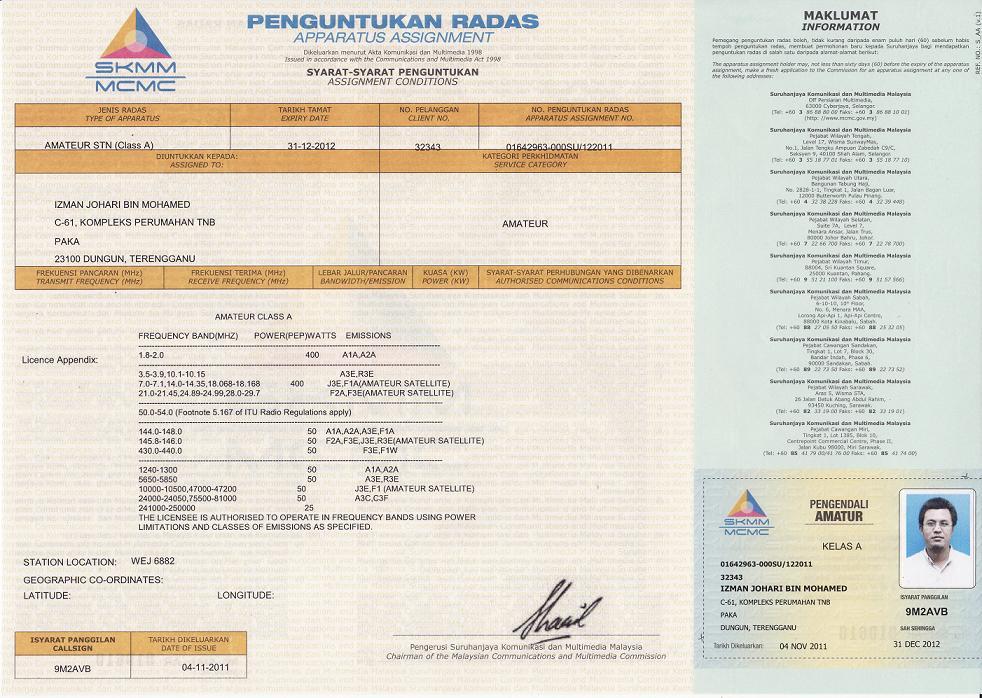
New Apparatus Assignment

Alhamdullilah ticket kelas A sudah dapat pada 4 November 2011 yang lepas. So boleh lah bekerja di mana-mana band.


Monday, October 10, 2011

Inverted Vee Antenna


An inverted vee antenna is a modified dipole antenna supported in the center with the ends lower than the center. Viewed from the side, it looks like the English letter "V" turned upside down, hence the name. Inverted vee antennas are commonly used by many amateur radio stations, and aboard sailing vessels requiring better HF performance than available with a short whip antenna
Typically, the inverted vee antenna requires only a single, tall support at the center (often a convenient tree limb), and the ends can be insulated and secured to anchors at or near ground level. This simplified arrangement has several advantages, including a shorter ground distance between the ends. For example, a dipole antenna for the 80 meter band requires a ground length of about 140 feet (43 m) from end to end. An inverted vee with a 40-foot (12 m) apex elevation requires only 115 feet (35 m). For radio amateurs living on small parcels of property, such savings can make it possible to use the lower frequency amateur bands.
In theory, the gain of an inverted vee is similar to that of a dipole at the same elevation because most of the radiation is from the high-current portion of the antenna, which is near the center. Since the center of both antennas are the same height, there is little difference in performance. Antenna modeling software bears this out for free-space models, predicting maximum gain of 2.15 dBi for the dipole and 1.9 dBi for the inverted vee
However, in practice, ground proximity and ground conductivity as well as end effects reduce the efficiency of the inverted vee considerably compared to the dipole: In the 40-foot example above, considering a useful take-off angle of 40 degrees above the horizon, the inverted vee produces a maximum gain of 1 dBi in a circular pattern, whereas the dipole produces an oval pattern ranging from 6 dBi toward the sides down to 1.2 dBi toward the ends.
Elevating the antennas higher above ground somewhat resolves the disparity, but considering the practical, legal and financial limits which influence most antenna installations, the inverted vee will be observably inferior in performance to a dipole by 1 to 2 S-units. However, if space is limited, an inverted vee may permit operation on frequencies that would not be possible with a full-sized dipole.